

Baxnet Blog · founder-note
What People Use Mimoto For
TL;DR: People have told us they use Mimoto for legal preparation, relationship reflection, wedding or anniversary gifts, group chat awards, and sometimes more professional review contexts.
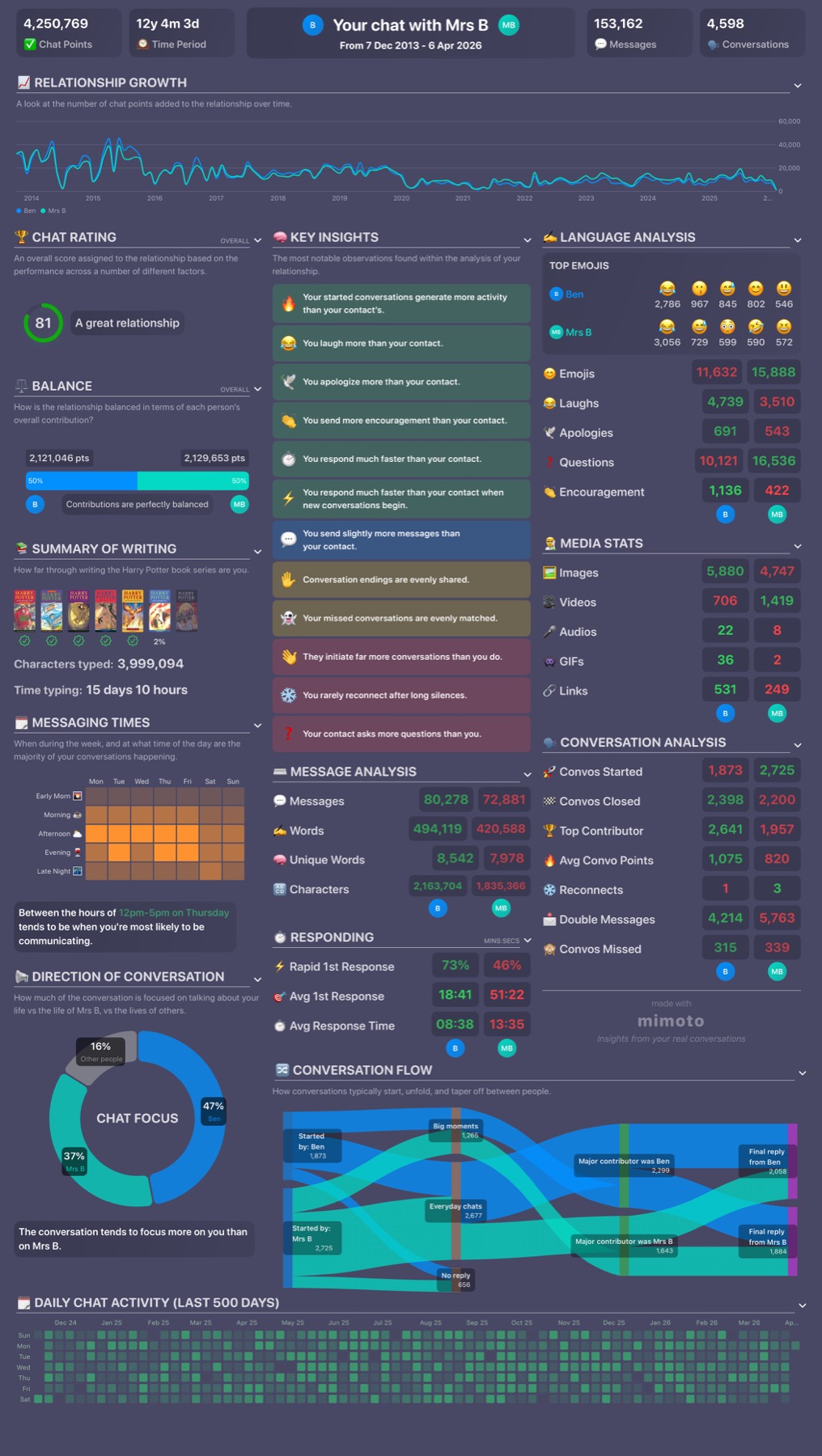
One thing we often get asked about Mimoto, given the slight niche it occupies and perhaps the quirkiness or weirdness of the product, is a very fair question: what is it actually for?
The best way I can answer that is not with a grand theory, but with the real-life examples we have seen from people who have reached out and told us what they are using it for.
So, in no particular order, these are some of the clearer use cases that have come back to us.
Message exports for legal preparation
One person was going through a legal case and simply wanted an easy way to access all of the messages he had with the person he had a case against.
That is one of the more straightforward uses of Mimoto. On the iMessage side, it can export the chat history of a particular conversation into formats such as CSV, which makes the material much easier to search through, filter, and analyse.
It is a simple feature in terms of the overall capability Mimoto offers, but an important one in that scenario. Sometimes the value is not a clever relationship report. It is being able to get the relevant conversation into a shape that a person can inspect calmly and, if needed, share selectively with someone qualified to advise them.
Related page: message exports for review or legal preparation.
Reports as a gift
Another use case we have seen a few people mention is the exportable report as a gift.
The idea is to print it, frame it, or present it to a partner. One person, in advance of her wedding, wanted to use the data as part of a presentation she was going to give. Hopefully a humorous one.
I like this use case because it is lighter than the serious preparation examples, but it still says something about why the product can matter. A relationship has a history. There are rhythms, inside jokes, bursts of conversation, quiet periods, and patterns that only make sense to the people involved. Turning some of that into a readable report can be a nice way to look back at the relationship, not just analyse it.
Related page: relationship reports from message history.
Pinpointing when a relationship changed
I also had one person reach out who said that after two of her best friends started going out together, she felt it had impacted her relationship with one of them.
They had stopped speaking, or at least spoke a lot less.
She was keen to pinpoint that exact moment in the relationship and see whether the data followed her assumption. In other words: did the conversation actually change around the time she felt it changed, or was it more of a perceived situation?
That was an interesting one to explore. It is exactly the sort of thing personal message data can be useful for, provided it is treated carefully. The data does not tell you the whole emotional truth of a friendship, but it can give you a timeline, a change in frequency, or a pattern that helps you ask a better question.
Situationships and early relationships
The most obvious use case we have seen, rightly or wrongly, is people in situationships or new relationships who are unsure whether the other person likes them or not.
These are probably the same people who visually analyse every chat message they have ever sent or received. Dare I say, they may also have used AI tools to overanalyse those messages.
What they seem to want from Mimoto is the statistical backup. Trend analysis. Message balance. Frequency. Response patterns. A way of seeing whether the thing they feel is actually showing up in the conversation history.
This is also where the product has to be careful. Mimoto can show patterns, but it should not pretend to be a relationship oracle. A chart can tell you that someone is replying less often. It cannot tell you, on its own, what that means.
Group chats and social capital
On the group side, everything is probably a little more lighthearted.
There is a bit of social capital to be gained, so to speak, when it comes to sharing the analysis with the group. It is a bit of a laugh.
We had one guy who was part of a football team’s WhatsApp group. He wanted to use the data as part of their end-of-season awards. So, alongside things like best player of the season or most improved, they also had an award specific to the group chat, or maybe a series of awards from the group chat.
I thought that was quite a neat idea. Group chats are often part logistics, part comedy, part community record. If you can make the analysis funny without making it invasive, there is a useful little social object there.
Related page: private chats, group chats, or both.
Professional curiosity
On the more serious side, I have also had people reach out who work in professions such as relationship counselling or psychology-related areas. The opportunity to potentially use this kind of data as part of their work was something that intrigued them.
This is an area I have probably avoided getting too close to, simply because I do not have the domain experience. I do not really have any right to try and operate in those areas without the right expertise around the table.
But it is intriguing to see how some people are looking at the opportunity that exists within this data. There may be serious professional uses here one day, but they would need much stronger guardrails, consent models, interpretation boundaries, and domain knowledge than a consumer app should casually claim.
That distinction matters.
The pattern underneath the examples
Taken together, these examples are a useful reminder that Mimoto is not only a novelty product and not only a serious documentation tool.
It sits somewhere between reflection, preparation, memory, and social analysis.
For one person, the useful output is a CSV file for a legal review. For another, it is a funny wedding presentation. For someone else, it is a way to understand when a friendship changed. For a football team, it is end-of-season group chat awards.
The common thread is that people are trying to turn private conversation history into something they can inspect, understand, or share on their own terms.
That is the product lesson I take from these examples. The value is not just “analyse my messages”. It is: help me use this private history for the situation in front of me, without taking the data out of my hands.
Mimoto is not a substitute for legal advice, therapy, relationship counselling, or professional judgement. It can help make message history easier to inspect, export, and reflect on, but the interpretation still belongs with the person using it and, in serious cases, the qualified professional they choose to involve.