
Baxnet Blog · technical-explainer
Private AI Is an Architecture Choice
Short answer: Private AI is not a sentence in a policy. It is a set of design choices about data movement and control.
The phrase “private AI” is starting to carry too much weight.
Sometimes it means the vendor promises not to train on your data. Sometimes it means encryption. Sometimes it means on-device processing. Sometimes it means data stays inside a jurisdiction or a company’s own infrastructure. Those are not the same thing, and users can feel the difference even when the marketing page treats them as interchangeable.
NTT DATA’s May 2026 Global AI Report announcement is a useful signal here. The research says more than 95% of respondents consider private and sovereign AI important, while only 29% are prioritizing sovereign AI in a concrete near-term way. The gap is telling. People and organizations want the trust boundary, but turning that into architecture is harder than writing the words.
That report is about enterprises, but the lesson travels down to consumer products. AI is forcing teams to decide where sensitive data lives, what leaves the device, what crosses a boundary, and which parts of the system are allowed to inspect the raw material.
For a personal insight engine, the most important privacy claim is not “we care about privacy.” It is a clear answer to a smaller question:
Where does the sensitive content go?
If a product analyzes private messages, journals, documents, or personal history, the architecture has to carry the trust. The user should not need to decode a legal page to understand whether their data is uploaded, retained, mixed into training data, or sent through a third-party model.
This is where local-first and on-device approaches matter. They are not automatically better for every product. Cloud systems can be appropriate when collaboration, backup, or heavy computation is the point. But when the source material is candid and personal, moving less of it is often the cleanest design.
The deeper shift is that privacy becomes a system property. It is not something you sprinkle on top once the product works. It changes model choice, storage design, export formats, analytics, support tooling, and even what features are worth building.
Mimoto sits inside that product worldview. If the goal is to help someone understand private message history, the architecture has to make the promise visible: analyze what is needed, expose useful reports, and avoid unnecessary movement of the raw content.
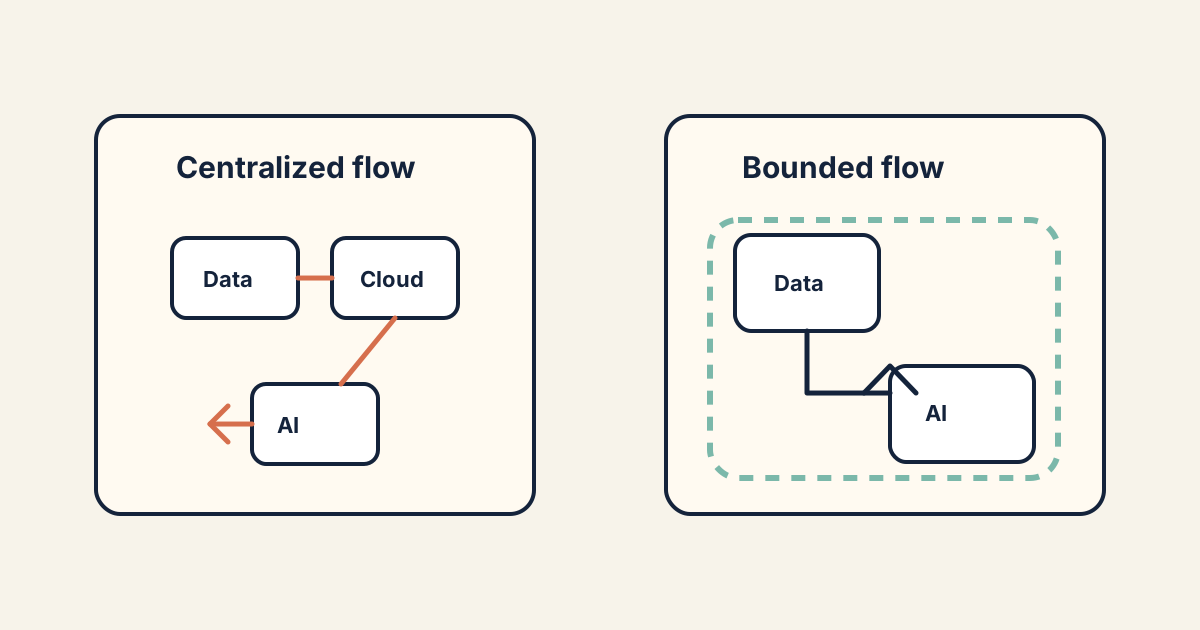
Take a message-analysis product. One architecture sends the full archive to a cloud model and depends on policy controls after upload. Another keeps the raw archive local, extracts only the report structure needed for the user, and avoids sending message content unless the user explicitly chooses an export or share action. Both can call themselves AI products. Only one makes the privacy boundary visible in the system design.
That is less dramatic than saying AI will know everything about you.
It is also a better product boundary.
Further reading: NTT DATA, “Enterprise AI Hits the Wall” (May 14, 2026).