

Baxnet Blog · technical-explainer
Privacy Rights Need Usable Interfaces
Short answer: A privacy right that people cannot find or complete is not a product boundary they can rely on.
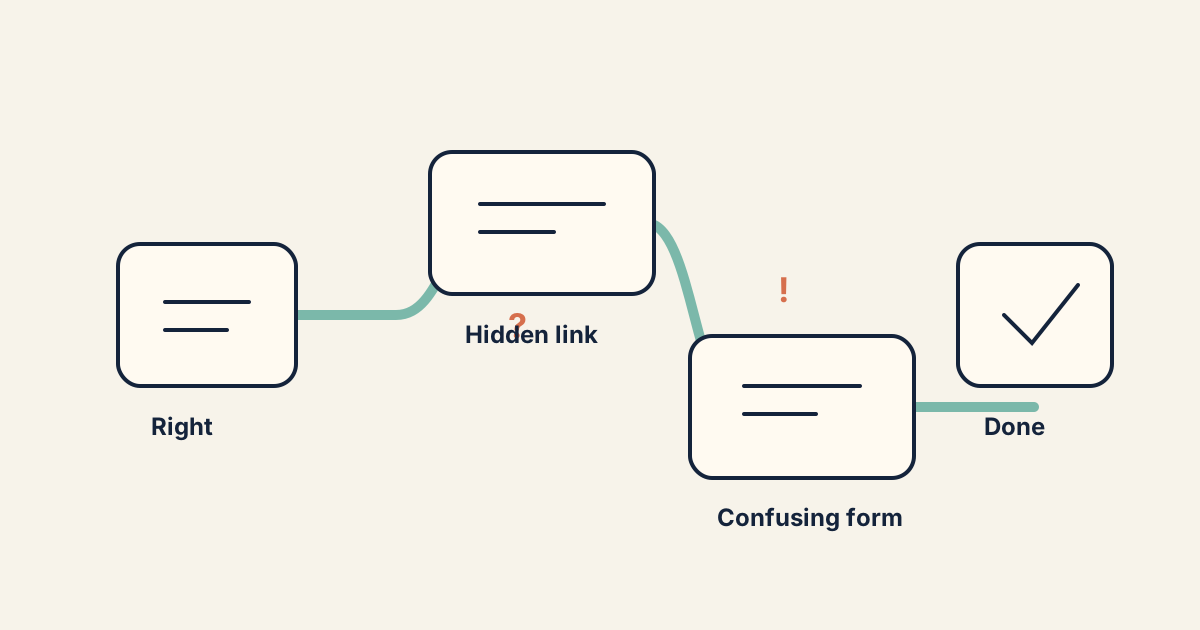
A privacy right can exist on paper and still fail in the interface.
That is the part people feel. They do not experience privacy law as a statute. They experience it as a link they cannot find, a form that asks for too much, a confusing label, a confirmation email, a broken flow, or a sense that the company would rather they gave up.
Two recent sources make the same point from different angles. A February 2026 U.S. Joint Economic Committee Minority report described how some data brokers made opt-out options harder to find, including by using “no index” code on pages that let people request deletion or stop sale of their data. A May 2026 research paper on California data broker compliance found that only 9% of 522 registered data brokers were fully compliant with transparency requirements after the Delete Act took effect.
The details are about data brokers, but the product lesson is broader.
Access, deletion, correction, export, and opt-out flows are not administrative leftovers. They are part of the trust surface.
If the user has to fight the product to exercise a right, the product is making a statement. It may be legalistic rather than emotional, but the user hears it clearly: you are allowed to control your data only if you can tolerate the friction.
That is a poor standard for personal intelligence tools.
When a product works with intimate data, the control paths should be easy to find and plain to understand. What does the system remember? What can be deleted? What can be exported? What stays local? What is sent elsewhere? What is the product unable to do?
Those questions should not live in a maze.
For Baxnet, this matters because personal insight engines depend on trust that can survive a second look. People may be willing to use a tool once because the idea is useful. They keep using it when the boundaries are clear enough to inspect.
The best privacy interface is not flashy. It is boring in the right way: visible, direct, and hard to misread.
A deletion request can be legally available and still feel unusable if the link is buried, the form asks for unclear identifiers, and the confirmation path disappears into email. A better interface states the action plainly, explains what will and will not be deleted, asks only for necessary verification, and gives the person a record of the request.
Further reading: U.S. Joint Economic Committee Minority, “Opt-Out Obstacles” (February 2026) and arXiv, “Privacy Without Remedy” (May 2026).