Baxnet Blog · technical-explainer
Personal Agents Need Permission Boundaries
Short answer: The more useful a personal agent becomes, the more clearly it needs to separate access from permission.
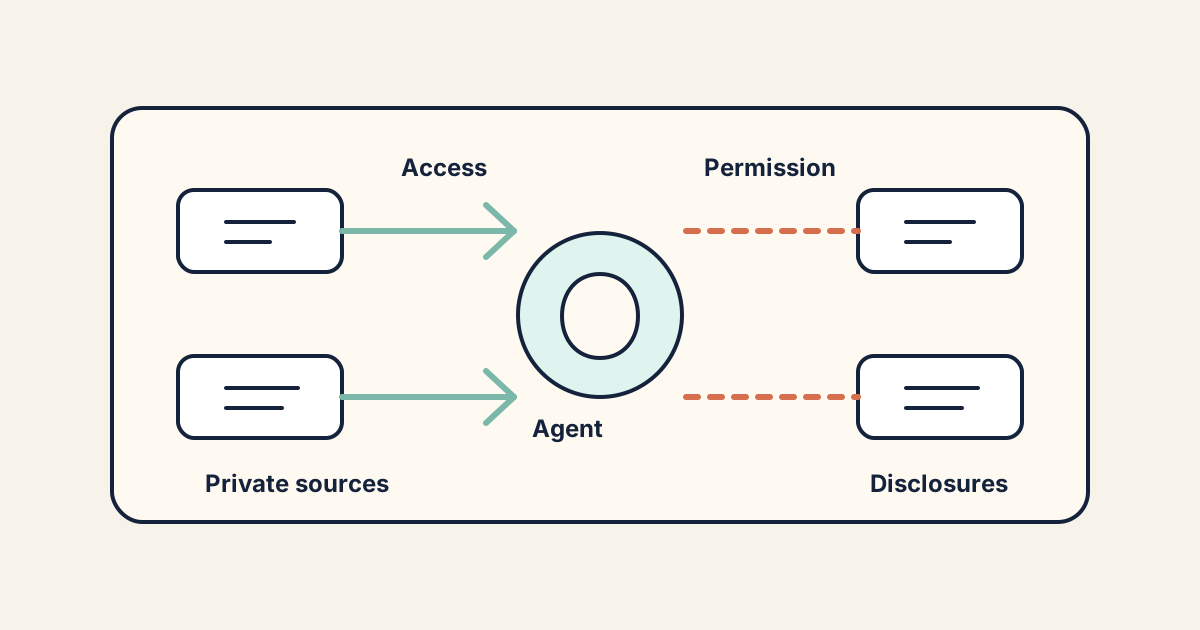
A useful personal agent needs access to things you would not casually hand to a stranger.
Calendar details. Messages. Documents. Financial context. Search history. The half-finished note where you said the honest version before cleaning it up. That is why agent privacy cannot be treated as a nicer consent screen. The agent’s job is to use private context, so the product has to decide what “use” actually means.
Recent research is starting to draw that boundary more carefully. A 2026 paper on GAAP, an AI agent execution environment, frames the problem directly: agents may need private user data, but attackers or compromised model providers can try to exfiltrate it. GAAP’s approach is to collect permission specifications from users and enforce how private data may be disclosed, including disclosures to the model provider.
Another 2026 paper, MemPrivacy, looks at personalized memory in edge-cloud agents. Its approach is to identify privacy-sensitive spans on edge devices, replace them with structured placeholders for cloud-side memory processing, then restore original values locally when needed. The interesting idea is not the specific technique alone. It is the separation: useful memory does not always require exposing the raw private value.
Access is not permission. That distinction matters for product design.
A user may allow a product to read a local file to produce a report. That does not mean the product should retain the file, train on it, send it to every model in the stack, or reveal sensitive fragments in a later answer. Access should be narrow. Permission should be understandable. Disclosure should be limited.
This is especially important for personal insight engines. The value often comes from sensitive material: private conversations, long-running patterns, emotional context, and details that make the analysis more accurate. The same details also raise the stakes.
One practical product question is worth asking again and again:
What is the smallest amount of private data the system needs to expose to produce the useful output?
That question does not solve everything. But it keeps the architecture honest.
For Mimoto, this points toward a product posture where private data is not treated as a general-purpose pool. It is source material for a specific user-controlled job: analyze this, explain this, export this, then keep the boundaries visible.
Suppose an agent can read a private conversation archive to produce a report. The user might permit local analysis for that one job, but not permit the raw messages to be retained, exposed to another model provider, quoted in a future answer, or used in a different workspace. A permission boundary turns that distinction into product behavior instead of relying on the user’s memory of a settings page.
Personal agents will become more capable. The ones worth trusting will also become more precise about permission.
Further reading: arXiv, “An AI Agent Execution Environment to Safeguard User Data” (April 2026) and arXiv, “MemPrivacy” (May 2026).