

Baxnet Blog · founder-note
Data Portability Needs to Be Usable
Short answer: People do not really own their data until the export becomes understandable enough to act on.
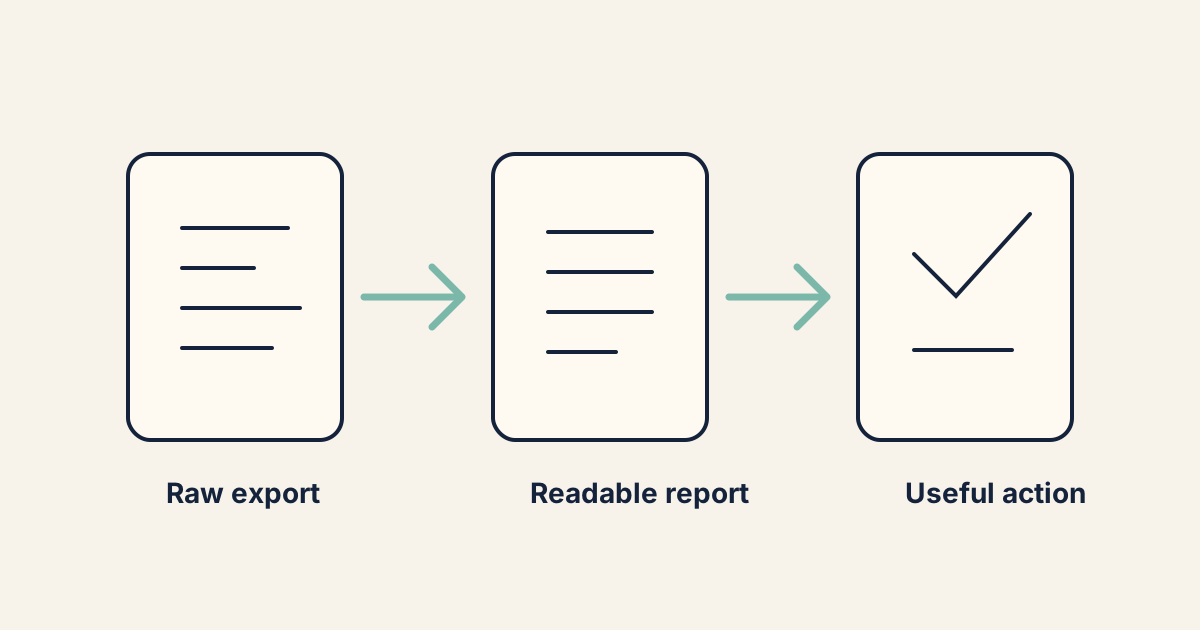
Most people do not want a folder full of files. They want an answer.
That is the awkward gap inside a lot of data portability talk. A person may have the right to request data, download data, or move data between providers. But once the archive lands on their computer, it often becomes a pile of JSON, CSVs, attachments, IDs, timestamps, and fields that only make sense to the system that created them.
Data portability is still important. A 2026 paper in the International Journal of Industrial Organization describes portability as the right for consumers to obtain and reuse personal data across providers, with related regimes appearing in the EU, Australia, China, India, and California. That is a real policy direction.
But for personal insight products, the product question starts after the export.
If someone exports message history, financial data, health records, or account activity, the hard part is not always possession. It is interpretation. What is in here? What changed over time? Which parts matter? What can be safely ignored? What should be turned into a report, a timeline, a search index, or a decision?
This is where personal insight engines have a useful job. They can sit between raw portability and practical agency.
Not by claiming to own the truth about a person’s life. That would be too much. But by making private data legible enough that the person can ask better questions of it.
For Mimoto, message exports are a good example. The value is not that a person can technically obtain a file. The value is that the file can become searchable, reviewable, and explainable without requiring the person to become a database administrator for their own conversations.
That is a small distinction, but it changes the product brief.
A real personal data economy should not stop at access. It should care about usability. Otherwise, ownership becomes a receipt for something the person cannot actually use.
Someone exports a message archive because they need to review a difficult relationship, prepare notes for a lawyer, or understand how a group conversation changed over time. The export itself may be technically complete, but not useful. A usable layer turns it into searchable conversations, timelines, summaries, and source-linked reports so the person can inspect the material without manually decoding the archive.
Further reading: ScienceDirect, “Data Portability and the Collection of Personal Data” (2026).